
In this guide
Glass partitions in Dubai homes solve a very local problem: deep apartment layouts with one glazed façade, where every solid wall you add steals daylight from the rooms behind it. A glass wall lets you carve out a study, close off a kitchen or separate a bedroom while the light keeps travelling through. This guide explains the main partition types, how framed and frameless systems compare, the glass specification that matters for safety, indicative 2026 costs in AED, the building NOC and other approvals involved, and the mistakes that turn a good idea into an expensive rework.
- Glass partitions divide space without losing daylight — the main reason they suit deep Dubai apartment layouts.
- Indicative 2026 costs run roughly AED 450–900 per sq m for frameless clear glass and AED 900–1,800 per sq m for slim black-framed systems, before doors.
- Use toughened (tempered) or laminated safety glass, typically 10–12 mm for full-height frameless panels; it cannot be cut after toughening.
- Most apartments need a building or developer NOC; partitions that affect sprinklers, smoke detectors or exits also involve Dubai Civil Defence requirements.
01Why glass partitions work so well in Dubai homes
Many Dubai towers were planned around a single long window wall, with kitchens, corridors and second rooms pushed deep into the floor plate. Add a plasterboard wall and the space behind it becomes a dark box that needs lights on at noon. Glass keeps the view line and the daylight while still giving you a door that closes, a quieter study or a kitchen that keeps cooking smells out of the living room.
Typical residential uses include a home office carved from a living room or large bedroom, a kitchen screen between an open kitchen and the lounge, a bedroom divider in a studio or a dressing area, and a shower enclosure, which is a separate, wet-area product with its own rules. If you are planning a workspace, our guide to home office interior design in Dubai covers lighting, acoustics and storage around the partition.
02Types of glass partitions: framed, frameless and specialty glass
- Frameless glass: full-height toughened panels held in slim floor and ceiling channels, joined with clear silicone or polycarbonate strips. The most minimal look and the most light, but the least acoustic privacy.
- Slim aluminium framed (black or bronze): the industrial, steel-look grid that has become a design favourite. Frames add rigidity, allow thinner glass in smaller panes and hide minor wall irregularities.
- Sliding and pivot glass doors: can be paired with either system; pivot doors look cleaner, sliding doors save floor space in tight rooms.
- Fluted or reeded glass: lets light through while blurring the view — popular for bathrooms, dressing rooms and kitchen screens.
- Frosted or tinted glass and films: a cheaper way to add privacy at desk or bed height.
- Switchable (smart) glass: turns from clear to opaque at the touch of a switch; impressive but several times the price and dependent on electrics.
- Double-glazed acoustic partitions: two panes with an air gap for a study or media room where sound separation matters.
How to choose between them: start from what the room has to do. A kitchen screen mainly stops smells and splashes, so frameless clear glass is usually enough. A study needs sound control and a door that seals, which points to a framed or double-glazed system. A bedroom divider needs privacy at night, so plan fluted glass, a film band or a curtain track from the start rather than as an afterthought.
03Tempered vs laminated glass: the safety specification
Interior glass at body height must be safety glass. Toughened (tempered) glass is four to five times stronger than ordinary float glass and, if it breaks, shatters into small blunt pieces. Laminated glass bonds two sheets with an interlayer, so a broken panel stays in place — the better choice near children's rooms, stairs and anywhere a fall through the glass is possible, and it also cuts sound a little better. For full-height frameless panels, 10–12 mm toughened glass is the usual range; framed systems with smaller panes can use 6–8 mm.
04Glass partition cost in Dubai: indicative 2026 ranges
The ranges below are indicative 2026 figures in AED for supply and installation in a typical apartment or villa, measured on the glass area. They exclude ceiling reinforcement, electrical changes and any approvals fees.
| System | Typical price | Best for |
|---|---|---|
| Frameless clear toughened, 10–12 mm | 450–900 per sq m | Studies, kitchen screens, maximum light |
| Slim black-framed aluminium grid | 900–1,800 per sq m | Design-led kitchens, bedroom dividers |
| Fluted, frosted or tinted glass | +15–35% on clear | Dressing rooms, bathrooms, privacy |
| Double-glazed acoustic partition | 1,500–2,800 per sq m | Home offices, media rooms |
| Switchable smart glass | 2,500–4,500 per sq m | Bedrooms, meeting areas, on-demand privacy |
| Glass door (hinged, pivot or sliding) | 2,500–7,000 per door | Added to any partition |
| Frameless shower enclosure | 2,500–7,500 per unit | Bathrooms |
What moves the price: panel height (anything over about 2.8 m needs thicker glass and more careful handling in lifts), the number of joints and corners, the door hardware, frame finish, and site conditions — uneven floors, a weak false ceiling or a tight delivery route all add labour. Small jobs carry a minimum charge, so a single 2 m kitchen screen rarely comes in at the per-metre rate.
05Approvals: building NOC, developer rules and Civil Defence
Rules vary by building and community, so treat this as a general picture. In most apartment buildings, adding a partition needs an NOC from the building management or community developer (for example Emaar or Nakheel communities), often with drawings, a contractor's trade licence and insurance, and a refundable deposit. Partitions do not usually touch structure, but if a new room changes how sprinkler heads, smoke detectors or exit routes cover the space, Dubai Civil Defence requirements apply and the building's fire consultant may need to review it. Villas in master communities follow the developer's modification process; our article on villa renovation community approvals in Dubai explains how that typically works.
Two technical points come up in almost every review: air conditioning (a fully enclosed glass room needs supply and return air, or it overheats) and lighting control (a new room needs its own switch). Both are cheap if planned in the drawings, and awkward after the glass is in.
06Installation process step by step
- Agree the layout, glass type, frame finish and door type, ideally as part of a wider interior design plan.
- Prepare shop drawings and apply for the building or developer NOC.
- Complete any ceiling reinforcement, AC grille changes and electrical points first.
- Finish the floor, ceiling and wall surfaces where the partition will sit.
- Take the final laser measurement on site.
- Fabricate and toughen the glass — typically 2–3 weeks, longer for smart or specialty glass.
- Install channels or frames, set the panels and doors, and seal the joints — usually 1–3 days for a home.
- Adjust door hardware, check the seals and clean, then hand over with care instructions.
07Shower enclosures vs room partitions
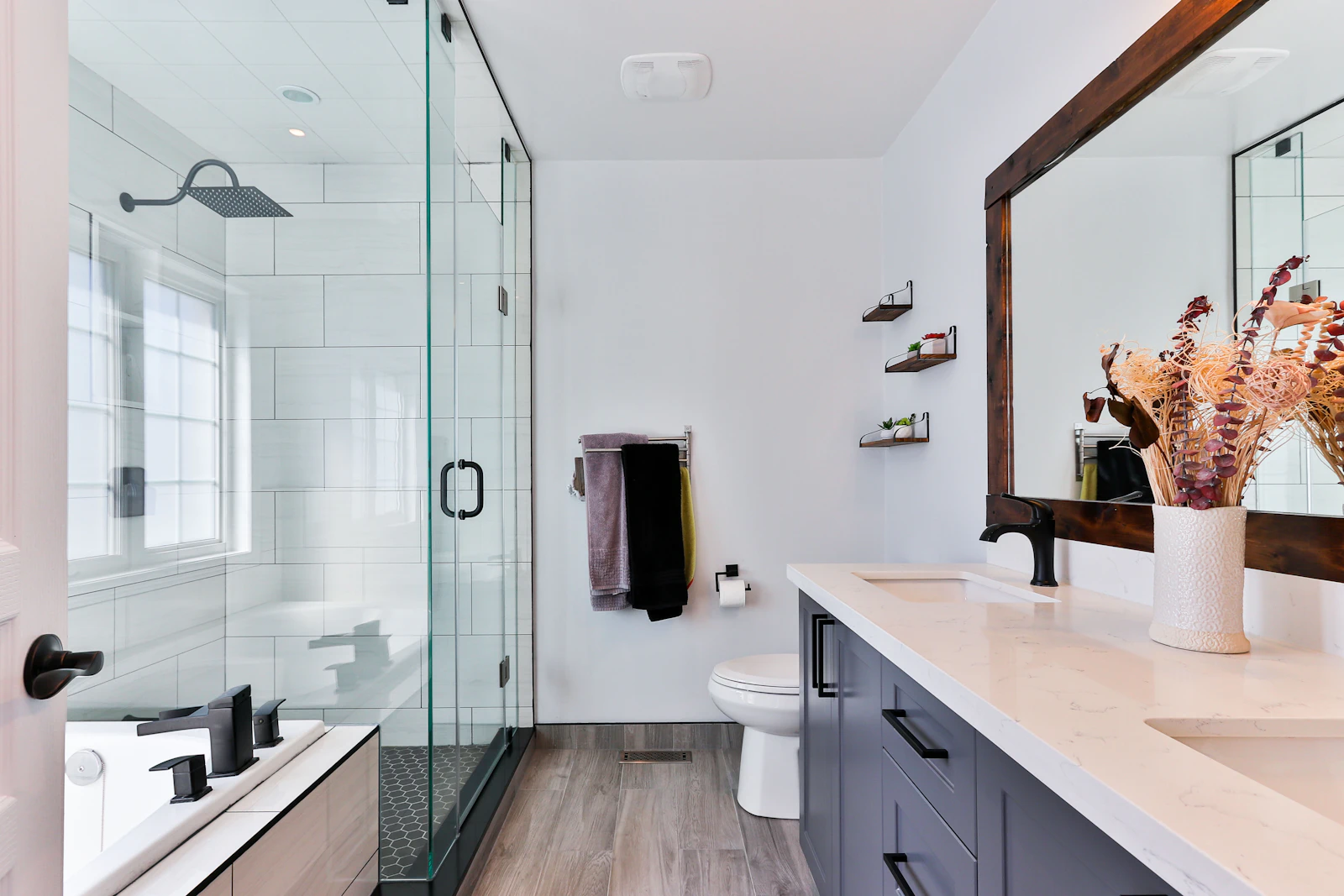
A shower screen looks like a small partition but behaves differently. It sits on a waterproofed floor, takes steam and limescale every day and relies on stainless or brass hardware rated for wet areas. The floor needs a correct fall to the drain before the glass is measured, and hinges must be fixed into solid backing, not just tile. Easy-clean coatings help a lot with Dubai's hard water. If the enclosure is part of a bigger job, it belongs in the bathroom renovation plan rather than being added afterwards.
08What goes wrong with glass partitions
- Expecting full soundproofing from single glass. A frameless panel with gaps under the door will not stop a video call being heard; plan seals or double glazing.
- Fixing into a light false ceiling. The top channel needs solid fixing or a steel support above the gypsum.
- Forgetting privacy. A clear glass bedroom wall looks great on day one; add fluted glass, film or curtains for night-time.
- No AC or switch in the new room. Glass rooms heat up fast in Dubai sun.
- Measuring too early. Toughened glass cannot be trimmed on site.
- Cheap hardware. Door hinges and handles fail long before the glass does.
09How A5renova installs glass partitions in Dubai
A5renova plans glass partitions as part of the whole room, not as a separate trade: our designers choose the system and glass with you, and our renovation team handles the NOC drawings, ceiling reinforcement, AC and electrical changes, measuring and installation in one sequence. If you are rethinking the layout more broadly, start with our design service, and we can finish the new room with made-to-measure curtains for privacy.