online[01]
Configure
Build your window online: type, fabric, sizes — instant price.
Made to measure, free survey and turnkey fitting. Build your window in the live configurator — the price updates instantly.
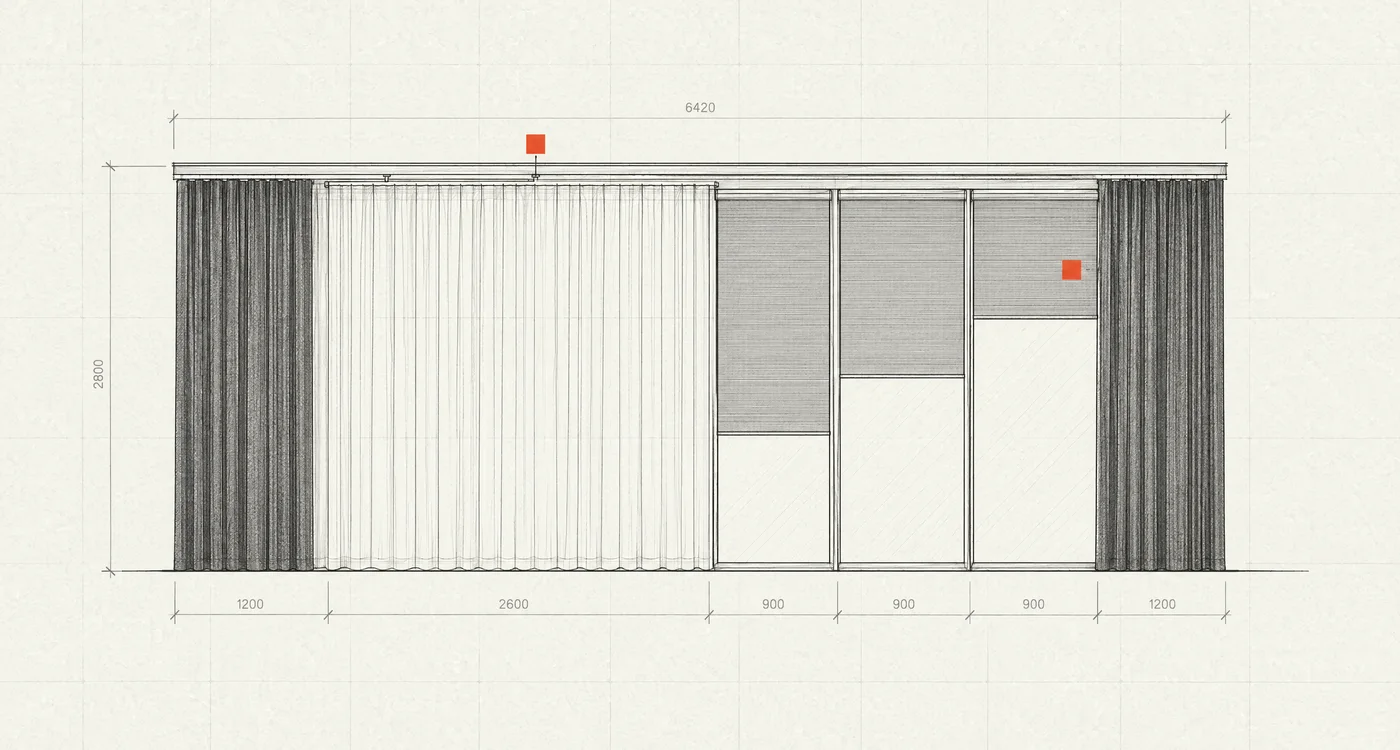
Switch type, fabric, opacity and control — the preview and indicative price update in real time.
Nothing found
Nothing found
· 164 fabrics
Indicative price incl. 5% VAT and fitting. The final cost depends on fabric and survey — a manager confirms the quote and offers a free on-site measure.
One survey visit, our own workshop and turnkey fitting. You choose — we do the rest.
Build your window online: type, fabric, sizes — instant price.
Free on-site measure with fabric samples.
Made to measure in our own workshop.
Tidy, turnkey fitting of tracks and mechanisms.
For full-height glass, a double-track system usually works best: a UV-stable sheer on the glass side for daytime glare and privacy, and a dim-out or blackout curtain with a light-coloured lining on the room side for darkness and heat control. Hang them from a ceiling-fixed aluminium track or a recessed ceiling pocket, extended beyond the glass so the curtains stack clear of the view.
Whichever sits closest to the glass with the fewest gaps. A blind fitted inside the reveal with a white or metallic backing reflects solar energy before it enters the room and generally outperforms a curtain hung 30 cm away. But a full-height blackout curtain with side returns and a good overlap beats a blind that leaks light at its edges. The strongest setup is both layered together.
Wave curtains form soft, even folds on a dedicated track and suit modern apartments, wide window walls and motorised systems. Pinch pleat curtains have a more tailored, classic look and work well in villas and formal rooms. Wave typically uses slightly less fabric and stacks more compactly, while pinch pleat gives a fuller, more structured drape. Both are available with blackout linings.
In most cases yes, especially on east and west elevations. Sunrise arrives early and low year-round, and west-facing bedrooms take strong late-afternoon heat. The usual specification is a layered double track with a sheer in front and blackout behind, with the blackout running wall to wall and returning at the sides. A pale lining on the window side keeps the room cooler than a dark one.
Yes, using a double track with two channels: the sheer runs on the room-side channel and the blackout on the glass-side channel. The channels should be spaced about 8–10 cm apart so a wave sheer does not catch on the blackout. Plan for the extra stack-back when both layers are open, and order the sheer at 2–2.5 times fullness and the blackout at about 1.8–2.2 so they look balanced.
On floor-to-ceiling glass, the ceiling is almost always the right choice, because there is no wall above the window for brackets. Fix the track to the slab or reinforced gypsum, or plan a recessed ceiling pocket during renovation for a hidden track. Wall mounting only works where there is a solid wall or bulkhead above the glass.
For wide or very tall glass, double layers and heavy blackout fabrics, usually yes. Motorised tracks prevent the pulling that wears out manual carriers, and they can close automatically during afternoon sun or open on a schedule. Wired motors need a ceiling power point, ideally planned before the ceiling is closed; battery motors avoid wiring but need periodic charging.
For sunny rooms, high-quality polyester or poly-linen blends are the most practical: they resist fading, stay stable in air-conditioning and are easy to clean. Natural linen and silk look beautiful but fade, crease and can shrink, so they need a good lining or a protected, north-facing position. For bedrooms, choose a blackout lining or coated blackout fabric to block the early morning sun.