
Sheer curtains in Dubai do a different job from sheers almost anywhere else. In a tower with floor-to-ceiling glass, a sheer is the layer that turns raw glare into usable daylight for ten hours a day, gives you privacy from the building opposite without closing the room, and takes the first hit of UV so your floors and sofa do not fade. Choose the wrong fabric and it yellows in a year; choose the wrong heading and it never hangs straight on a 3.2-metre drop. This 2026 guide covers the fabrics that actually work in the heat, how to layer sheers with blackout on a double track, wave versus pleated headings, ceiling tracks and motorisation, and what sheer curtains cost per metre and per window in Dubai.
Key takeaways
- In Dubai a sheer is a working layer, not decoration: it cuts glare, adds daytime privacy and reduces UV fading on floors and furniture.
- Polyester and polyester-linen blends outlast pure linen and cotton in the sun; look for fabrics rated for UV stability and choose white or off-white to slow yellowing.
- A double track with sheer in front and blackout behind is the standard Dubai setup: sheer by day, blackout at night, and both fully open when you want the view.
- Indicative 2026 prices: about AED 90–350 per running metre of fabric made up, or roughly AED 900–3,500 per typical window installed, with motorisation adding AED 1,200–2,500 per track.
Why sheer curtains in Dubai are a working layer, not a finishing touch
Most Dubai apartments and villas have large glazing with a west or south exposure somewhere, and the glass alone does not manage the light. Without a sheer you have two states: full glare with the blackout open, or a dark room with it closed. The sheer creates the third state, the one you live in for most of the day.
- Glare control: a medium-density sheer softens direct sun into diffuse light that you can read a screen against.
- Daytime privacy: in a tower or a villa facing a neighbour, a sheer makes the interior invisible from outside in daylight while you still see out. At night the effect reverses, which is why the blackout layer matters.
- UV and heat: a sheer will not replace solar film or blinds, but it takes the first hit of UV and reduces fading on wood floors, rugs and upholstery and slightly eases the AC load on a west-facing wall of glass.
- Softening the architecture: floor-to-ceiling sheers on a ceiling track turn a wall of aluminium and glass into a soft edge.
Sheer curtain fabrics that survive the Dubai sun
The fabric decision is the one people get wrong most often, usually by choosing on touch and colour in a showroom rather than on how the fibre behaves after two summers behind west-facing glass. Heat behind glass runs well above room temperature and UV is intense most of the year, so fibre stability matters more than it does in a European catalogue.
| Fabric | Sun and heat resistance | Look and feel | Fabric price per metre (AED) |
|---|---|---|---|
| Polyester voile | Very good; UV-stable grades resist yellowing | Smooth, light, crisp; the classic white sheer | 40–120 |
| Polyester-linen blend | Good; keeps the linen texture with far less fading and shrinkage | Textured, matte, natural; the current favourite | 80–220 |
| Pure linen | Moderate; softens and can yellow or shrink on sunny elevations | The most natural drape and slub | 150–400 |
| Cotton voile | Lower; fades and weakens faster in direct sun | Soft, matte, slightly heavier | 60–150 |
| Trevira CS or FR polyester | Very good; inherently flame-retardant | Slightly firmer hand; required in many commercial spaces | 120–300 |
For a living room with direct afternoon sun, a UV-stable polyester or a polyester-linen blend in white, ivory or a pale stone is the safe choice. Save pure linen for north-facing rooms or elevations shaded by a balcony. Colour matters as well: white and off-white show yellowing least, while greys and beiges can shift visibly on one side of the room after a year in the sun. The blackout curtains guide covers the same fabric logic for the opaque layer.
Layering sheer and blackout curtains on a double track
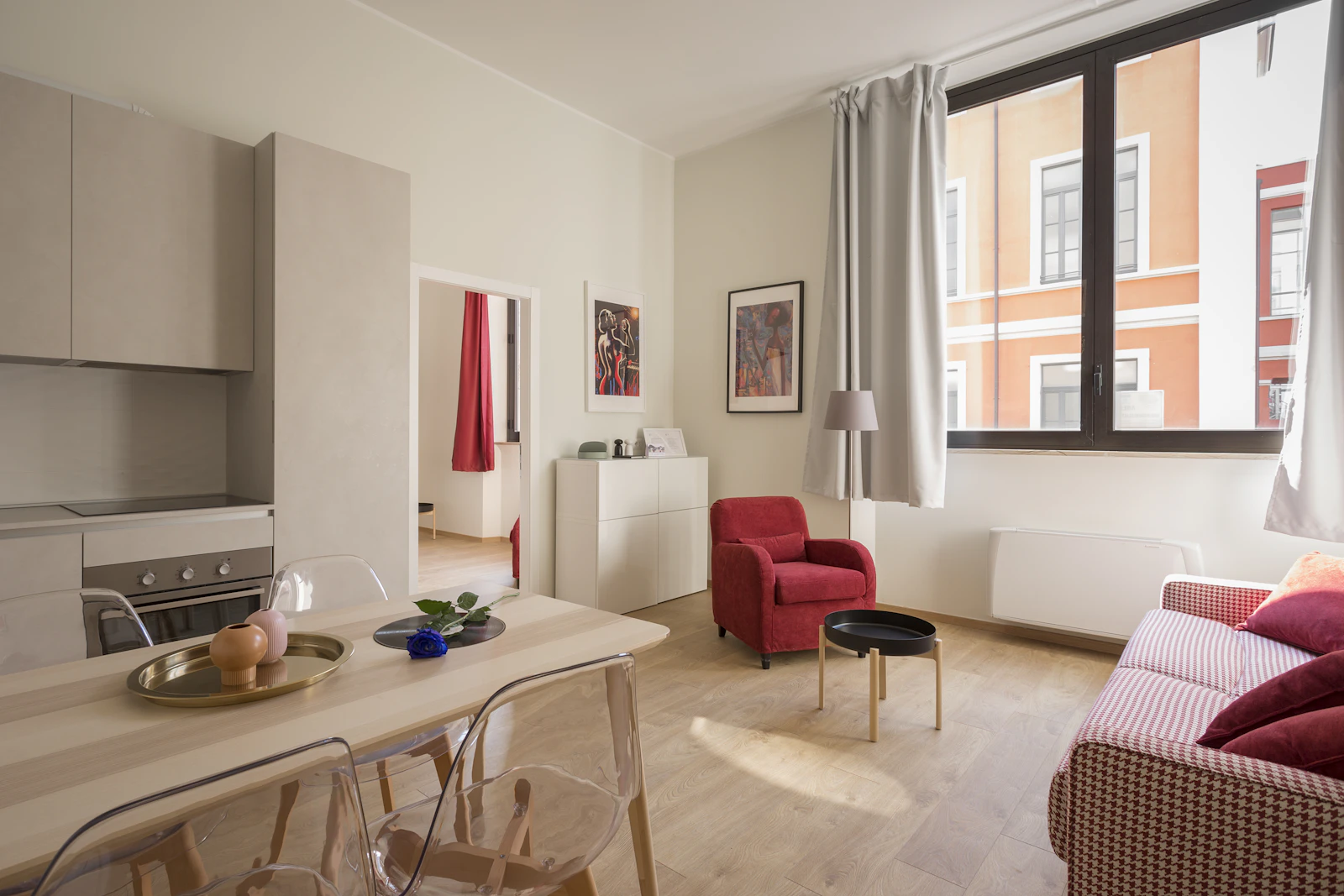
The standard Dubai setup is a two-layer system on a double track: sheer on the room side, blackout behind it against the glass. In the day you close the sheer and open the blackout; at night you close the blackout, or both. Both layers stack to the side when you want the full view. Three details decide whether this works or annoys you every day:
- Track spacing: the two channels need enough separation, usually 8–10 cm, so the fuller sheer does not catch on the blackout when both move. Cheap double tracks put the channels too close and the wave crushes.
- Stack-back: two layers take up more wall when open. On a 4-metre window a wave sheer plus blackout can stack to 60–80 cm each side; plan for that when you place furniture and side tables.
- Fullness: a sheer needs 2 to 2.5 times the track width in fabric to look full; a blackout usually works at 1.8 to 2.2. Ordering both at the same fullness makes one of them look either skimpy or bulky.
- Matching drops: both layers should finish at the same height, either kissing the floor or with a 1 cm gap. A puddle on a sheer looks luxurious in a photograph and collects dust in a week.
If you do not want a blackout layer in a living space, a sheer alone still earns its place for glare and privacy. In bedrooms, though, a sheer without blackout means a 5.30 am summer sunrise, so treat the two layers as a set there.
Wave, pencil pleat or eyelet: which heading for a sheer
The heading is the way the fabric is gathered at the top, and it defines how a sheer hangs on a tall Dubai window more than the fabric does.
- Wave (S-fold): a continuous soft S-curve on a track with wave gliders and a wave tape. The cleanest look on floor-to-ceiling glass, stacks tight, and is the default for modern Dubai interiors. Needs a proper wave track and a sheer with enough body to hold the curve.
- Pencil pleat: a gathered tape with hooks; forgiving on uneven ceilings and works on rods or tracks. Reads more classic and a little busier at the top.
- Double or triple pinch pleat: tailored, hand-set pleats. Elegant on villas with a traditional or transitional scheme, more sewing time, higher price.
- Eyelet (grommet): metal rings on a rod. Simple and cheap but the rod must be exposed, and on a 3-metre drop the rings tend to stick.
Ceiling tracks, pelmets and motorised sheers
If you are renovating, plan the track before the ceiling is closed. A recessed curtain box in the gypsum ceiling, typically 15–20 cm wide for a double track, hides the hardware so only fabric shows. In a finished apartment a surface-mounted track with a slim pelmet achieves most of the effect. Building rules are simple: fixing a track to the ceiling or wall inside your unit needs no NOC in most Dubai towers, but drilling into the facade frame or external glazing is almost always prohibited, so tracks should never rely on the window frame.
Motorising a sheer makes sense on wide spans and where the double layer is used several times a day. A motorised wave track for a 4-metre living room glass runs roughly AED 1,200–2,500 extra per track in 2026, and a sheer track is often the layer people motorise first because it moves most often. Our motorised curtains guide covers the choice between battery and wired motors and how they tie into smart-home scenes.

What sheer curtains cost in Dubai in 2026
Curtains in Dubai are usually priced per running metre of finished curtain, which already includes the fullness, or per window as a package with track and installation. The 2026 ranges below are indicative for made-to-measure sheers; ready-made sheers from a store are far cheaper but rarely fit a 3-metre drop.
| Item | Budget | Mid-range | Premium |
|---|---|---|---|
| Sheer made up, per running metre of track | 90–150 | 150–250 | 250–350+ |
| Double track (sheer + blackout), per metre, installed | 60–100 | 100–180 | 180–300 |
| Typical 3 m living-room window, sheer only, installed | 900–1,500 | 1,500–2,500 | 2,500–3,500+ |
| Same window, sheer + blackout on double track | 1,800–3,000 | 3,000–5,000 | 5,000–8,000+ |
| Motorisation, per track | 1,200–1,600 | 1,600–2,000 | 2,000–2,500+ |
What moves the number: the fabric itself and its fullness, the heading (wave and pinch pleat cost more to make than pencil pleat), drop height over 3 metres, the track quality, and whether the installer has to build a pelmet or curtain box. A two-bedroom apartment with sheers throughout and blackout in the bedrooms typically lands somewhere between AED 8,000 and 25,000 in 2026 depending on those choices. The curtain configurator lets you price fabric, heading and motorisation for your own window sizes before you book a measure.
From measure to installation: how the process runs
Made-to-measure sheers in Dubai take two to four weeks from the site measure to a hung curtain, longer for imported fabrics. A good supplier follows the same steps:
- Site measure: the installer measures the track position, drop at both ends (floors are rarely level), stack space and any obstructions such as AC grilles or curtain boxes.
- Fabric samples in your light: hang A4 samples at the actual window for a day. Whites can read blue or yellow against Dubai daylight.
- Heading, fullness and lining decisions: wave or pleat, fullness ratio, whether a blackout layer is included and how the two will stack.
- Track installation: fixed to the ceiling or wall inside the unit, never to the facade frame; motor cabling run and tested if motorised.
- Making up: sewing, weighting the hem so a sheer hangs straight, and pressing.
- Hanging and dressing: the curtains are hung, the wave is trained by tying it in position for a few days, and drops are checked against the floor.
Mistakes to avoid and how to keep sheers looking new
The mistakes that cost most are ordering sheers too short because the measure was taken at one end only, choosing pure linen for a west-facing wall, fitting eyelets on a rod above 2.5 metres, and under-ordering fullness: a flat sheer at 1.5 times fullness looks like a hospital screen rather than a curtain.
Care is straightforward in Dubai's dry, dusty climate. Vacuum sheers with a soft brush every few weeks, and machine wash polyester sheers on a cool, gentle cycle two or three times a year, rehanging them damp so they drop straight. Linen and blends prefer a professional clean. If one panel on the sunny side is yellowing faster, rotate it with a shaded one. Well-chosen polyester sheers last eight to ten years behind Dubai glass; cheap voiles and pure cotton often show their age in two.
How A5renova specifies and fits sheer curtains in Dubai
Our curtains service starts with the window, not the fabric book: we measure the drop at both ends, check the ceiling for a recessed box or a pelmet, and hang samples in your light before you choose. We specify UV-stable polyesters and linen blends as standard on sunny elevations, make up sheers at proper fullness with weighted hems, and fit double tracks with the spacing a wave heading needs. Where a renovation is under way, we coordinate the curtain box and motor cabling with the interior design and ceiling works so nothing is retrofitted later, and motorised tracks can be tied into your smart-home scenes. Price fabric, heading and motorisation for your own windows in the configurator, then book a measure.
Frequently asked questions
How much do sheer curtains cost in Dubai?+
As an indicative 2026 range, made-to-measure sheer curtains in Dubai cost about AED 90–350 per running metre of track made up, or roughly AED 900–3,500 for a typical 3-metre living-room window installed. Adding a blackout layer on a double track takes the same window to about AED 1,800–8,000 depending on fabric and heading, and motorisation adds AED 1,200–2,500 per track. Fabric, fullness, drop height and the heading move the number most.
Which sheer curtain fabric is best for the Dubai sun?+
UV-stable polyester voile and polyester-linen blends perform best behind Dubai glass: they resist yellowing, shrinking and weakening far better than pure linen or cotton, which can show wear within two summers on a west- or south-facing elevation. Choose white, ivory or pale stone to hide any colour shift. Save pure linen for north-facing or shaded windows where its natural drape is worth the lower durability.
Can you layer sheer and blackout curtains on one track?+
Yes, using a double track with two channels: the sheer runs on the room-side channel and the blackout on the glass-side channel. The channels should be spaced about 8–10 cm apart so a wave sheer does not catch on the blackout. Plan for the extra stack-back when both layers are open, and order the sheer at 2–2.5 times fullness and the blackout at about 1.8–2.2 so they look balanced.
Do sheer curtains give privacy in a Dubai apartment?+
In daylight, yes: a medium-density sheer makes the interior invisible from outside while you can still see out, which is why they are so common in towers and villas facing neighbours. At night the effect reverses, because the lit interior is brighter than outside, so you need the blackout layer or a blind for evening privacy. Denser sheers and textured linen-look weaves give more daytime privacy than very fine voiles.
Wave or pleated sheer curtains: which is better?+
Wave (S-fold) is the default for modern Dubai interiors with floor-to-ceiling glass: it hangs in a clean continuous curve, stacks tightly and suits ceiling tracks and motorisation. It needs a proper wave track and a fabric with enough body to hold the curve. Pencil and pinch pleats are more classic, forgiving on uneven ceilings and work on rods as well as tracks. Eyelets are best avoided on tall windows.
Do I need a NOC to install curtain tracks in a Dubai apartment?+
Generally no: fixing a curtain track to the ceiling or an internal wall inside your unit is treated as furnishing in most Dubai towers and does not need a building NOC. What is almost always prohibited is drilling into the facade frame or the external glazing system, so tracks should never be fixed to the window frame. If a renovation is building a recessed curtain box in a new ceiling, that forms part of the wider fit-out NOC.
Related services