
In this guide
Waterproofing in Dubai is the layer nobody sees and everybody pays for when it is missing: a failed shower membrane shows up as a stain on the neighbour's ceiling, a leaking balcony as swollen skirting and mould behind the wardrobe. This 2026 guide explains where an apartment or villa really needs waterproofing, which systems suit wet rooms, balconies and roofs, indicative costs per square metre in AED, the process a good contractor follows — including the flood test — and the mistakes that turn a small renovation into a building-management dispute.
- Waterproofing belongs under the tiles in every wet area, on balconies and terraces, and on flat villa roofs — not just in the shower tray.
- Indicative 2026 ranges: roughly AED 60–180 per sq m for wet rooms and AED 70–220 per sq m for roofs and terraces, depending on system and condition.
- A 24–48-hour flood test before tiling is the single cheapest insurance in any bathroom or balcony job.
- Most leaks come from details — drains, pipe penetrations, wall–floor corners and thresholds — not from the membrane itself.
01Why waterproofing matters more in Dubai than you think
Dubai rarely sees heavy rain, so owners tend to treat waterproofing as an afterthought. The real load comes from elsewhere: daily showers in compact bathrooms, washing machines in kitchens and laundry cupboards, balcony cleaning, irrigation on villa terraces, condensate from AC units and, on roofs, extreme temperature swings that crack rigid coatings. When it does rain, it tends to come in short, intense bursts that find every weak point at once.
In a tower, a leak is never only your problem. Water travels through slab joints and service shafts and appears one or two floors below, and building management will usually ask the owner of the unit above to open up and repair at their own cost. That is why waterproofing is a core part of any renovation scope, and why it is worth understanding before you approve a bathroom or balcony quote.
02Where an apartment or villa actually needs waterproofing
A proper scope covers every surface that sees standing or regular water, not only the obvious ones:
- Showers and wet rooms — the full floor plus walls to at least 1.8–2 m in the shower zone; walk-in showers and level-access floors need the whole room treated.
- Bathroom floors outside the shower — with an upstand of 100–150 mm up the walls and across the door threshold.
- Kitchens and laundry areas — under the sink run and washing-machine position, especially in open-plan layouts where a leak reaches parquet.
- Balconies and terraces — under the tiles, with correct falls to the drain and a sealed connection at the sliding-door frame.
- Flat villa roofs and roof terraces — usually a membrane plus insulation and screed, renewed as part of a larger villa renovation.
- Planters, water features and pools — anything holding water or wet soil against a structure.
If you are only replacing tiles, the question is whether the existing membrane survives demolition. In most cases it does not: chiselling off old tiles damages it, so a tile replacement in a wet area should be priced as a new waterproofing layer.
03Waterproofing methods compared: liquid, sheet and cementitious
There is no single best product; there is a right system for the surface, the movement it sees and what goes on top of it.
| System | Best for | Strengths | Watch-outs |
|---|---|---|---|
| Liquid-applied membrane (polyurethane, acrylic, hybrid) | Bathrooms, balconies, complex shapes | Seamless, easy around pipes and drains | Needs correct thickness and full curing; thin coats fail |
| Cementitious flexible slurry | Wet rooms under tiles, pools, planters | Bonds well to screed, tile-friendly surface | Limited flexibility over moving cracks |
| Bituminous / modified-bitumen sheet | Flat roofs, large terraces | Proven, robust over big areas | Laps and upstands must be torched or sealed properly |
| Sheet membranes with fleece (bonded) | Showers, level-access floors | Uniform thickness, fast tile-over | Joints and corners rely on accessory tapes |
| Exposed PU / polyurea coatings | Roofs without tiles, service areas | No screed, UV-resistant grades | Surface prep critical; more expensive per sq m |
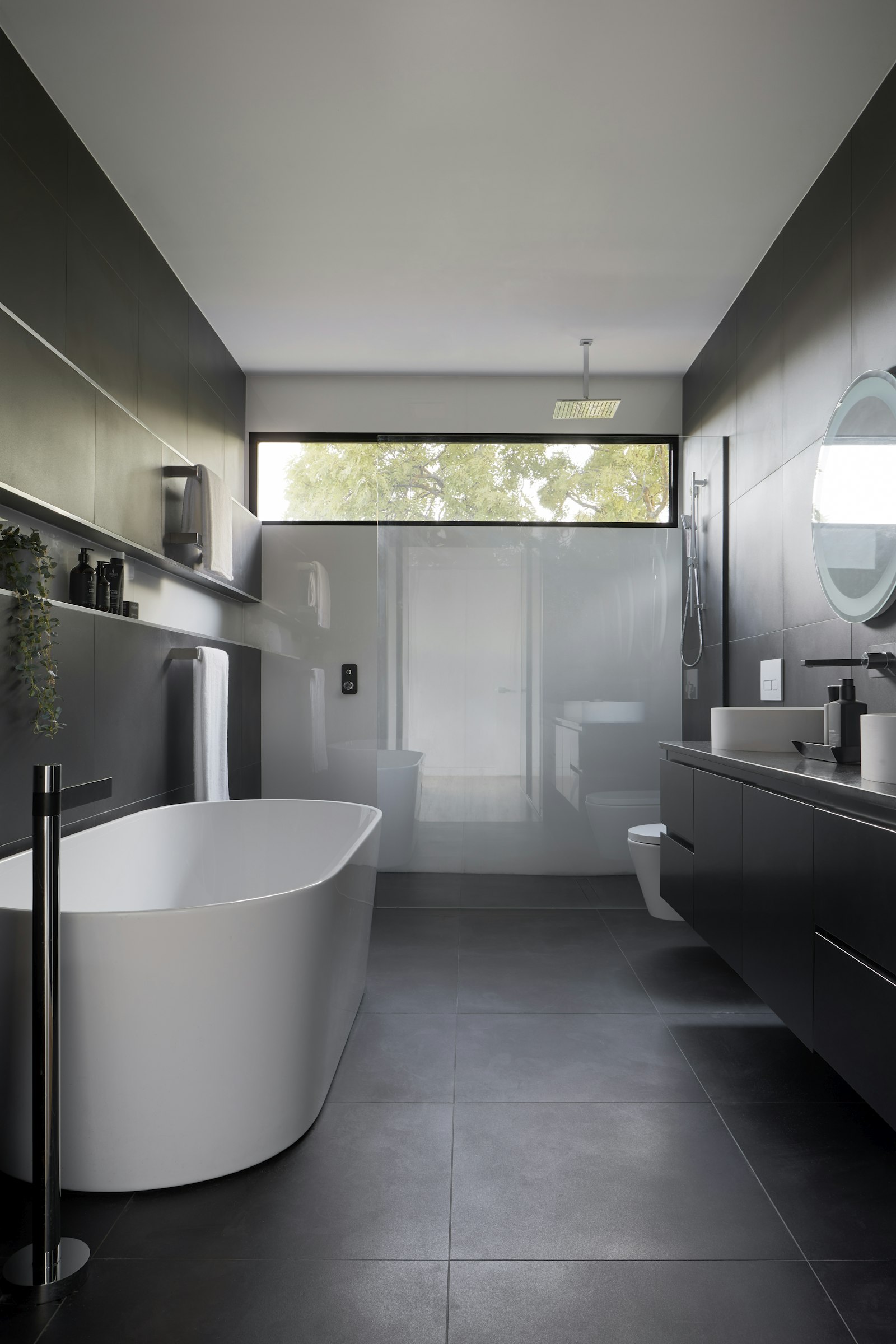
In a typical apartment bathroom, a liquid or cementitious membrane with reinforcing tape in all corners is the norm. Under microcement the membrane matters even more, because a seamless finish has no grout lines to dry out through and hairline cracks show water quickly.
04How much does waterproofing cost in Dubai in 2026?
Waterproofing is usually priced per square metre of treated area, including upstands. The ranges below are indicative 2026 figures for supply and application; demolition, screed and tiling are separate.
| Area | Typical system | Indicative range |
|---|---|---|
| Apartment bathroom (5–8 sq m incl. walls) | Liquid or cementitious + tapes | AED 800–2,500 per bathroom |
| Walk-in shower / wet room | Sheet or liquid membrane, full room | AED 90–180 per sq m |
| Balcony or small terrace | Liquid membrane under tiles | AED 70–160 per sq m |
| Flat villa roof (re-roofing) | Membrane + insulation + screed | AED 120–220 per sq m |
| Leak investigation and local repair | Testing, opening up, patch | AED 500–3,000+ per issue |
What moves the number: how much old material has to come off, whether the screed has to be relaid to correct the falls, the number of drains and penetrations, access (a high-floor balcony with materials carried through the apartment costs more), and whether a manufacturer-backed warranty is required. A cheap quote often hides a thinner coat or skipped primer. In a full bathroom budget waterproofing is a small line — see our bathroom renovation cost guide — so it is the last place to economise.
05The right waterproofing process, step by step
Good waterproofing is mostly preparation and detail. A contractor who works in this order rarely has call-backs:
- Strip and inspect — remove old tiles and adhesive to the slab or sound screed; check for cracks, damp and existing leaks.
- Correct the falls — screed so water runs to the drain; a flat floor will pond no matter how good the membrane is.
- Prime — apply the primer the system specifies to a clean, dry, dust-free surface.
- Detail first — reinforcing tape or fleece in every wall–floor corner, around drains, pipe penetrations and the door threshold.
- Apply the membrane — usually two coats at the specified thickness, the second at right angles to the first, with upstands up the walls.
- Cure and flood test — let it cure fully, then plug the drain and hold water for 24–48 hours; check below and around for any trace.
- Protect and tile — tile with a compatible adhesive, avoid drilling through the membrane, and seal movement joints with flexible silicone.
06What usually goes wrong — and how to spot it early
Most failures are not bad products but bad junctions. The usual suspects:
- Drains not bonded to the membrane — water runs under the tiles around the drain body and into the slab.
- Upstands too low — splash zones and wall corners left untreated, so water wicks into plasterboard or block.
- Thresholds ignored — water crosses under the bathroom door or balcony slider and soaks the adjacent floor.
- Membrane punctured after the fact — screws for glass screens, niches or towel rails drilled straight through.
- Rigid systems on moving substrates — roofs and balconies move with heat; a non-flexible coating cracks within a few summers.
Early warning signs are easy to miss: grout that stays dark long after a shower, hollow-sounding tiles, efflorescence on balcony tiles, a musty smell in a fitted wardrobe or peeling paint at skirting level. If you are buying or receiving a new unit, these are exactly the points a snagging inspection should test.

07Building rules, NOCs and warranties
In most towers, any work that touches wet areas or balconies needs a building or landlord NOC, and many developers and community managers (Emaar, Nakheel and others) specify approved systems, require a flood test record or insist on a licensed contractor. Rules vary by building, so check the fit-out guidelines before you sign. Villa roof works may also need community approval, and anything structural or involving new drainage connections can involve Dubai Municipality.
On warranties: a credible contractor gives a written workmanship warranty, typically somewhere between 2 and 10 years depending on the system and area, and can provide the manufacturer's data sheet for what was used. A warranty is only as good as the records behind it, so keep the product name, photos of each stage and the flood-test result with your property documents — they matter when you sell or let.
08How A5renova handles waterproofing
We treat waterproofing as part of the job, not an extra: every wet area and balcony in our renovation projects gets the system specified for that surface, taped details, a recorded flood test before tiling and a written warranty, and we coordinate the building NOC and any community requirements for you. If you are planning a bathroom refresh or a full apartment or villa refit, we can combine it with interior design so the layout, drains and finishes are decided once — send us photos and floor plans and we will tell you honestly whether the existing membrane can stay.
