
Choosing between blinds and curtains in Dubai is a thermal decision before it is a decorative one. In a city where a west-facing window can push a living room several degrees above the rest of the apartment by four in the afternoon, the fabric you hang is part of the cooling system, not just the styling. This guide compares blinds and curtains on the three things that actually matter here — heat, glare and privacy — goes room by room through a typical Dubai apartment and villa, gives indicative 2026 prices in AED for both, and covers the measuring and fitting details that decide whether the result looks made-to-measure or merely bought.
Key takeaways
- Heat is won or lost at the glass: a light, reflective backing close to the window does more for temperature than a heavy dark fabric hung a foot away.
- The strongest setup for Dubai is layered — a sheer or a light-filtering blind for daytime glare, plus blackout for heat and sleep.
- Indicative 2026 ranges: roller blinds around AED 250–900 per standard window, made-to-measure curtains around AED 600–3,500, motorisation AED 1,200–3,500 per track.
- Decide on recess versus wall mounting and a gypsum curtain pocket before the ceilings close — retrofitting either one means cutting finished work.
What a Dubai window actually demands
Most window-covering advice is written for climates where the main enemy is a draught. Here the brief is different, and it is worth naming the four loads before choosing a product:
- Solar heat gain — from roughly April to October, direct sun on unshaded glass is the single largest heat load in a Dubai apartment. West and south-west elevations take the worst of it, in the late afternoon, exactly when people come home.
- Glare — the sky here is bright even when the sun is not on your facade. North-facing rooms rarely overheat but are still unusable for screen work at midday without some diffusion.
- Privacy at close range — towers in Marina, JLT, Business Bay and Downtown often face each other across a narrow gap. Privacy is a daytime and night-time problem, and the two have opposite solutions.
- Dust and cleaning — after a shamal, anything with horizontal surfaces or slats collects a visible film. This is a genuine deciding factor between venetians and rollers in practice.
One physical point drives nearly everything that follows: heat is stopped most effectively at the glass, and by reflection rather than absorption. A pale, reflective backing fitted tight into the window reveal outperforms a heavy dark fabric hung 30 cm away, because the dark fabric absorbs the energy, heats up and then radiates it into the room. That is why the best-performing installations in Dubai are almost always layered, and why the layer nearest the glass should be light-coloured on the window side.
Blinds and curtains in Dubai: how each one performs
Neither is simply better. They fail differently, and knowing how helps you place them:
| Blinds | Curtains | |
|---|---|---|
| Heat control | Strong when fitted inside the reveal with a reflective backing; weak if there are gaps at the sides | Strong with blackout lining and generous overlap, but only if the fabric extends well past the opening |
| Glare control | Excellent and adjustable — slats and day-night fabrics let you keep the view while cutting the brightness | All or nothing unless you layer a sheer; a sheer diffuses beautifully but cannot be aimed |
| Privacy | Adjustable; zebra and light-filtering fabrics give daytime privacy with light | Sheer by day plus blackout by night is the most complete solution |
| Look and acoustics | Clean and minimal; adds almost nothing acoustically | Softer room, noticeably better echo and a modest help with outside noise |
| Cleaning | Wipe down; slat types collect dust quickly in Dubai | Periodic professional cleaning; no daily dust ledges |
| Cost per window | Lower — the cheapest credible option | Higher, especially layered on a double track |
| Best for | Kitchens, bathrooms, home offices, study areas, tall narrow windows | Bedrooms, living rooms, anywhere floor-to-ceiling glass dominates |
The short version: use blinds where you need precise control of light during the day and easy cleaning, and curtains where you need heat, darkness and a room that feels finished. In most Dubai apartments the answer is both, and the made-to-measure curtains configurator is set up around that combination rather than forcing a choice.
Blind types that actually suit Dubai homes
Five types cover almost every situation you will meet in a Dubai apartment or villa:
- Roller blinds — the default. Available in light-filtering, screen and full blackout fabrics. Ask specifically for a white or metallic backing on any dark fabric; it is the difference between a blind that reflects heat and one that stores it.
- Screen / solar fabric rollers — an open-weave fabric rated by openness factor (3% and 5% are the common Dubai choices). They cut glare and a good share of solar gain while keeping the view, which is why they are the right answer for a home office overlooking the skyline.
- Zebra / day-night blinds — alternating sheer and opaque bands that slide over each other. One product covering both daytime diffusion and evening privacy, useful for tower apartments facing another tower.
- Honeycomb (cellular) blinds — pleated fabric with trapped air cells. The best purely thermal performer of the group and the quietest-looking, but the priciest and less forgiving of dust.
- Venetian and vertical blinds — aluminium venetians give precise glare aiming in a kitchen or bathroom; verticals still make sense on very wide sliding doors. Both collect dust noticeably faster than a flat roller.
Whatever the type, the fitting decision matters as much as the product. A blind mounted inside the reveal looks neater and performs better thermally, but only if the reveal is deep enough and the wall is straight; a wall-mounted blind with generous overlap is more forgiving and blocks more edge light. On floor-to-ceiling glass with no reveal at all — which is most of Marina, Downtown and Business Bay — the honest answer is usually a ceiling-fixed track rather than a blind.
Where curtains beat blinds
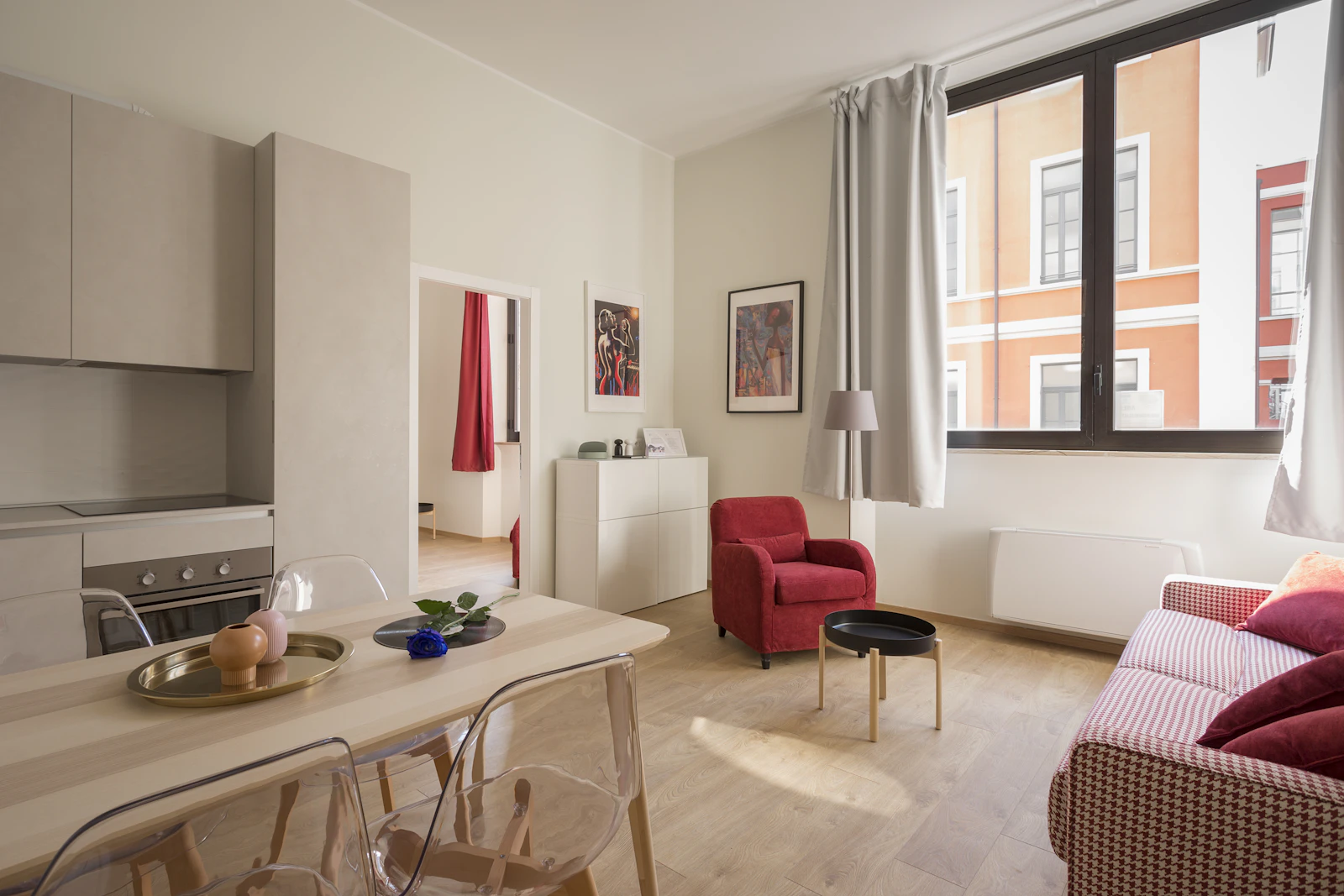
Curtains win on three counts that blinds cannot really address. The first is complete darkness: a properly made blackout curtain with side returns and a generous overlap in the middle beats any blind, because blinds leak light at the edges by design. The second is the feel of the room — fabric softens the hard surfaces that dominate Dubai interiors and measurably reduces echo, which is why a living room with tiles, glass and a gypsum ceiling sounds better with curtains in it. The third is scale: floor-to-ceiling glass simply looks right with full-height fabric and wrong with a three-metre blind.
The setup that performs best here is the layered one: a sheer on the front track for daytime diffusion and privacy, blackout behind it for heat and sleep. Our guides to sheer curtains and blackout curtains cover the fabric choices in detail; the practical rules are to use a fullness of at least 2 to 2.5 times the track width so the fabric still reads as gathered when closed, to run the track from wall to wall rather than just across the glass, and to keep the blackout lining pale on the window side.
Room by room in a Dubai apartment or villa
Applying all of the above to a typical layout:
- Master bedroom — layered sheer plus blackout, full height, wall to wall. This is the one room where it is worth spending for total darkness; sleep quality in a west-facing Dubai bedroom depends on it.
- Living room with floor-to-ceiling glass — ceiling-track sheers as the default daytime layer, with blackout or a dim-out behind if the room faces west or is used for film nights.
- Home office — a 3% or 5% screen roller. It kills glare on the monitor without blacking out the view, which no curtain can do as precisely.
- Kitchen — roller or aluminium venetian. Avoid heavy fabric near cooking; it holds odours and grease.
- Bathrooms — moisture-tolerant roller or a frosted film. Fabric here is a maintenance problem, not a feature.
- Children's rooms — blackout for daytime naps, and cordless or motorised operation for safety. Loose cords are worth eliminating on principle.
- Villa double-height windows and stairwells — motorised is effectively mandatory; nobody operates a five-metre curtain by hand twice a day.
If the whole property is being furnished at once, it is worth choosing window treatments alongside the rest of the scheme rather than at the end. Fabric, wall colour and upholstery read very differently under Dubai daylight than under showroom lighting, which is a good argument for settling them together with interior design and the furnishing package.
What blinds and curtains cost in Dubai in 2026
Prices below are indicative 2026 ranges for made-to-measure products supplied and fitted, expressed per standard window of roughly 2.5 m wide by 2.7 m high. Floor-to-ceiling glass, wide sliding doors and double-height windows scale up from here.
| Product | Indicative price (AED) | Notes |
|---|---|---|
| Basic roller blind, light-filtering | 250–500 | Polyester fabric, manual chain, standard cassette |
| Blackout roller blind | 400–900 | Coated fabric; side channels add cost but stop edge light |
| Screen / solar roller (3–5% openness) | 450–1,000 | Best value for glare control with a retained view |
| Zebra / day-night roller | 500–1,100 | One product for daytime privacy and evening opacity |
| Aluminium venetian | 350–800 | Good for kitchens and bathrooms; dust needs regular wiping |
| Honeycomb / cellular | 700–1,600 | Strongest thermal performance of the blind types |
| Sheer curtains, made to measure | 600–1,500 | Fabric, making, track and fitting; fullness drives the price |
| Blackout curtains, lined | 1,200–3,500 | Lining quality, fullness and track length move the number |
| Layered sheer plus blackout, double track | 1,800–4,500 | The standard Dubai bedroom specification |
| Motorisation, per track or blind | 1,200–3,500 | Motor, power supply and app or hub integration |
What moves these numbers: fabric origin and weight, fullness ratio, track length and whether it is curved, motorisation, and access — a double-height villa window needs scaffolding or a lift, and that appears on the invoice. Motorising a whole apartment is usually cheaper per unit than doing one room, and cheaper still if it is specified with the rest of the smart home rather than added afterwards; our guide to motorised curtains covers where it is genuinely worth it.
Measuring, ordering and fitting without regrets
Most disappointing window treatments in Dubai are not badly made — they are badly measured or badly sequenced. A reliable order of operations:
- Decide mounting first — inside the reveal or wall/ceiling fixed. This changes every subsequent measurement, so it cannot be an afterthought.
- Measure each window individually — never assume two identical-looking windows are identical. Measure width in three places and height in three, and work to the smallest for a recess fit.
- Check what is behind the wall — gypsum linings, concealed AC ducting and window-frame reinforcement all decide where fixings can actually go. This is the most common cause of a rescheduled installation.
- Sort power before you order motors — a motorised track needs a supply point at the right end of the window. Adding it later means chasing a finished wall or running trunking.
- See fabric samples in the room — hold them against the glass at midday and again in the evening. Dubai daylight is far brighter than any showroom and shows sheers very differently.
- Confirm the fullness and the overlap in writing — the quote should state the fullness ratio and the side returns, because these are where a cheap quote quietly saves money.
- Install after painting, before furniture — fitting brackets into fresh paint is fine; painting around installed tracks is not.
One landlord-related point worth checking early: in many towers and communities, anything visible from outside is regulated. Building management may specify the colour of the lining facing the glass — plain white or off-white is the usual requirement — so that the facade reads uniformly. Confirm it before you commission anything bespoke, and confirm whether drilling into the window frame or the ceiling near the facade needs approval.
How A5renova handles blinds and curtains
We measure on site, make to size and fit, which means one party is responsible for the result rather than a supplier blaming a fitter. You can configure fabric, lining, fullness and track online through the curtains configurator and we will confirm everything against real measurements before anything is cut. If the apartment is being renovated, we coordinate the curtain pocket, the track fixings and the power for motors with renovation and fit-out while the ceilings are still open, and match fabrics to the scheme with interior design so the windows are part of the room rather than the last thing anyone thought about. Send us the floor plan and the orientation of each window and we will tell you honestly which openings want a blind and which want fabric.
Frequently asked questions
Are blinds or curtains better for heat in Dubai?+
Whichever sits closest to the glass with the fewest gaps. A blind fitted inside the reveal with a white or metallic backing reflects solar energy before it enters the room and generally outperforms a curtain hung 30 cm away. But a full-height blackout curtain with side returns and a good overlap beats a blind that leaks light at its edges. The strongest setup is both layered together.
How much do blinds cost in Dubai?+
As an indicative 2026 guide for supply and fit, a basic light-filtering roller blind runs about AED 250–500 per standard window, a blackout roller AED 400–900, a screen or solar roller AED 450–1,000, a zebra day-night blind AED 500–1,100, and honeycomb blinds AED 700–1,600. Motorisation adds roughly AED 1,200–3,500 per blind. Window size, fabric brand and access difficulty move all of these.
What blinds are best for floor-to-ceiling windows in Dubai?+
On genuine floor-to-ceiling glass with no reveal, a ceiling-fixed curtain track usually works better than a blind, both visually and for stopping edge light. If you want blinds, use wide roller blinds with side channels, or a screen fabric with 3 to 5% openness so you keep the view while cutting glare. Motorisation is close to essential on anything above about three metres.
Do I need blackout curtains in Dubai bedrooms?+
In most cases yes, especially on east and west elevations. Sunrise arrives early and low year-round, and west-facing bedrooms take strong late-afternoon heat. The usual specification is a layered double track with a sheer in front and blackout behind, with the blackout running wall to wall and returning at the sides. A pale lining on the window side keeps the room cooler than a dark one.
Can I install blinds and curtains in a rented apartment in Dubai?+
Usually yes, but check your tenancy agreement and the building rules first. Drilling into ceilings, window frames or facade-facing walls may need landlord or building management approval, and many towers require the lining visible from outside to be plain white or off-white so the facade looks uniform. Tension-fitted or recess-mounted blinds are the least invasive option if drilling is restricted.
How long do made-to-measure curtains and blinds take in Dubai?+
Typically about two to four weeks from the site measurement to installation for locally made curtains and blinds, depending on fabric availability. Imported fabrics and motorised systems can take six to eight weeks. If the property is under renovation, the measurement should happen once walls and ceilings are finished but before painting is complete, so installation lands after paint and before the furniture arrives.
Related services